Ravenhush: a free sci-fi horror game for the browser
· 4 min read · three.js, webgpu, tsl, game-dev, horror, announcement
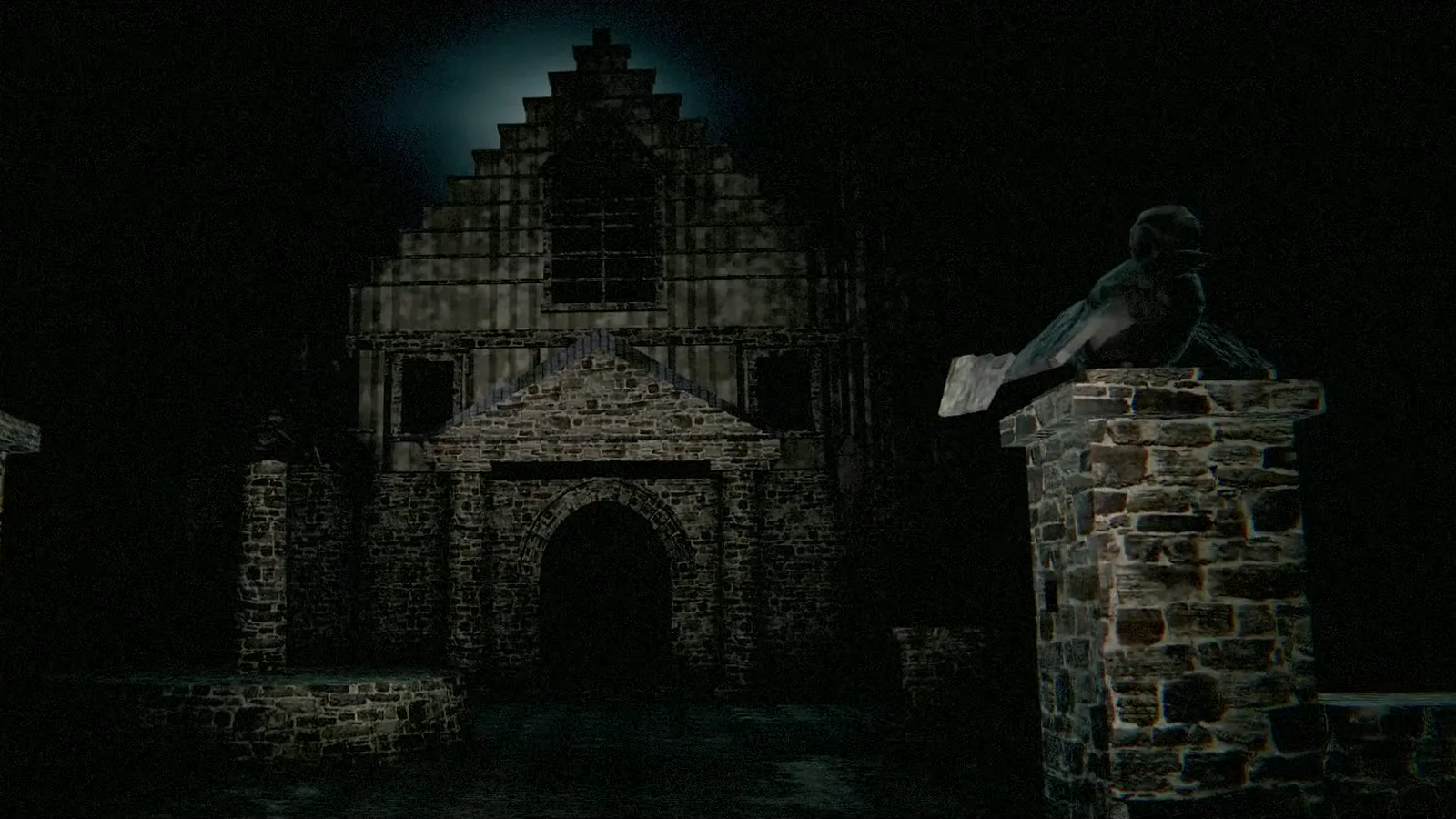
Ravenhush is a free first-person horror game that runs in a browser tab. You come to on a road through a dead forest, at night, in heavy fog. There is a flashlight in your hand that you did not bring, and you do not remember how you got there. The prologue says it in four cards: you were returned.
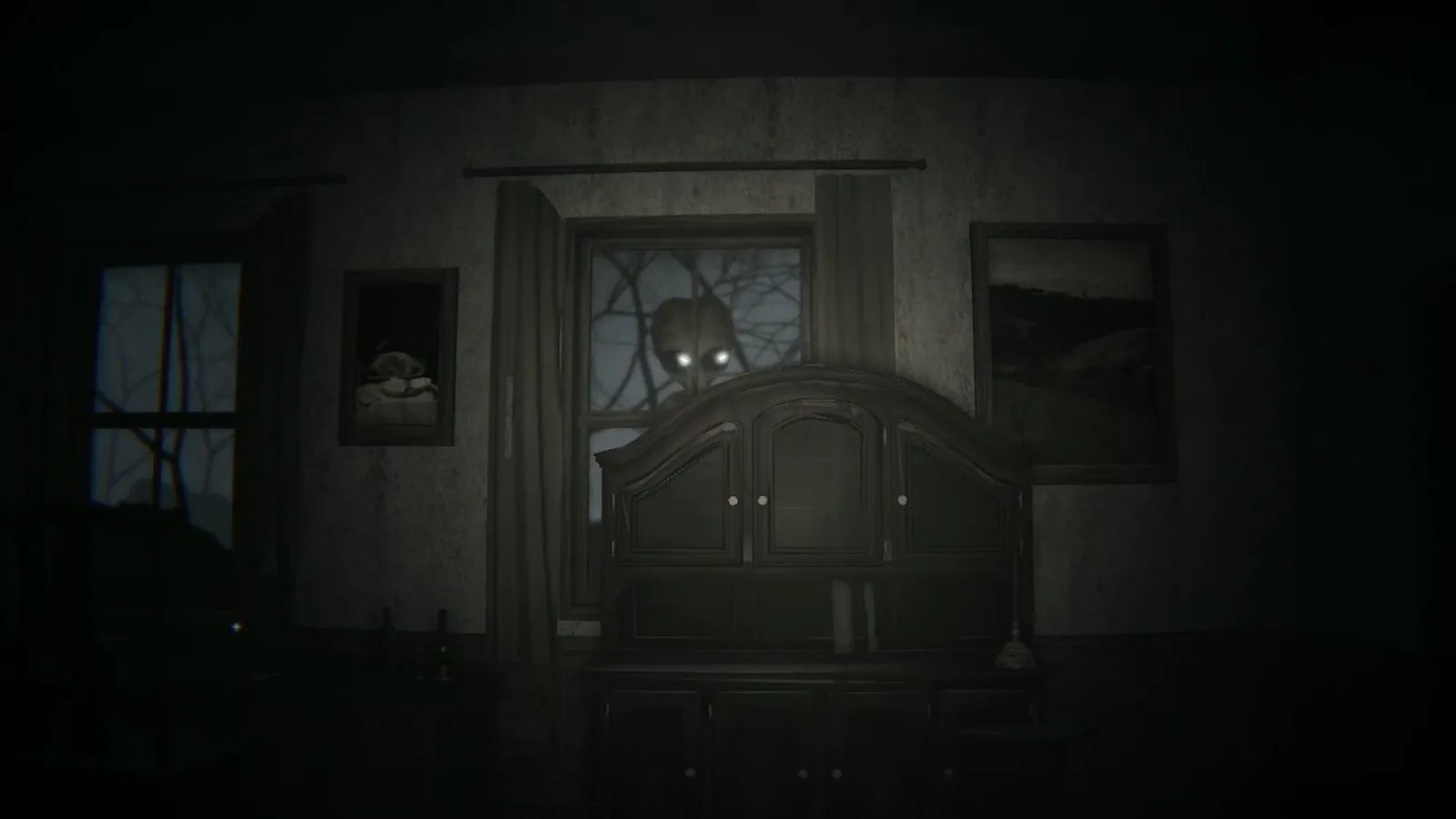
It is horror with a bit of science fiction in it. What follows you in the trees is not a ghost. The Greys are almost not there, and what you see of them is two pale points, their eyes, at the edge of the beam.
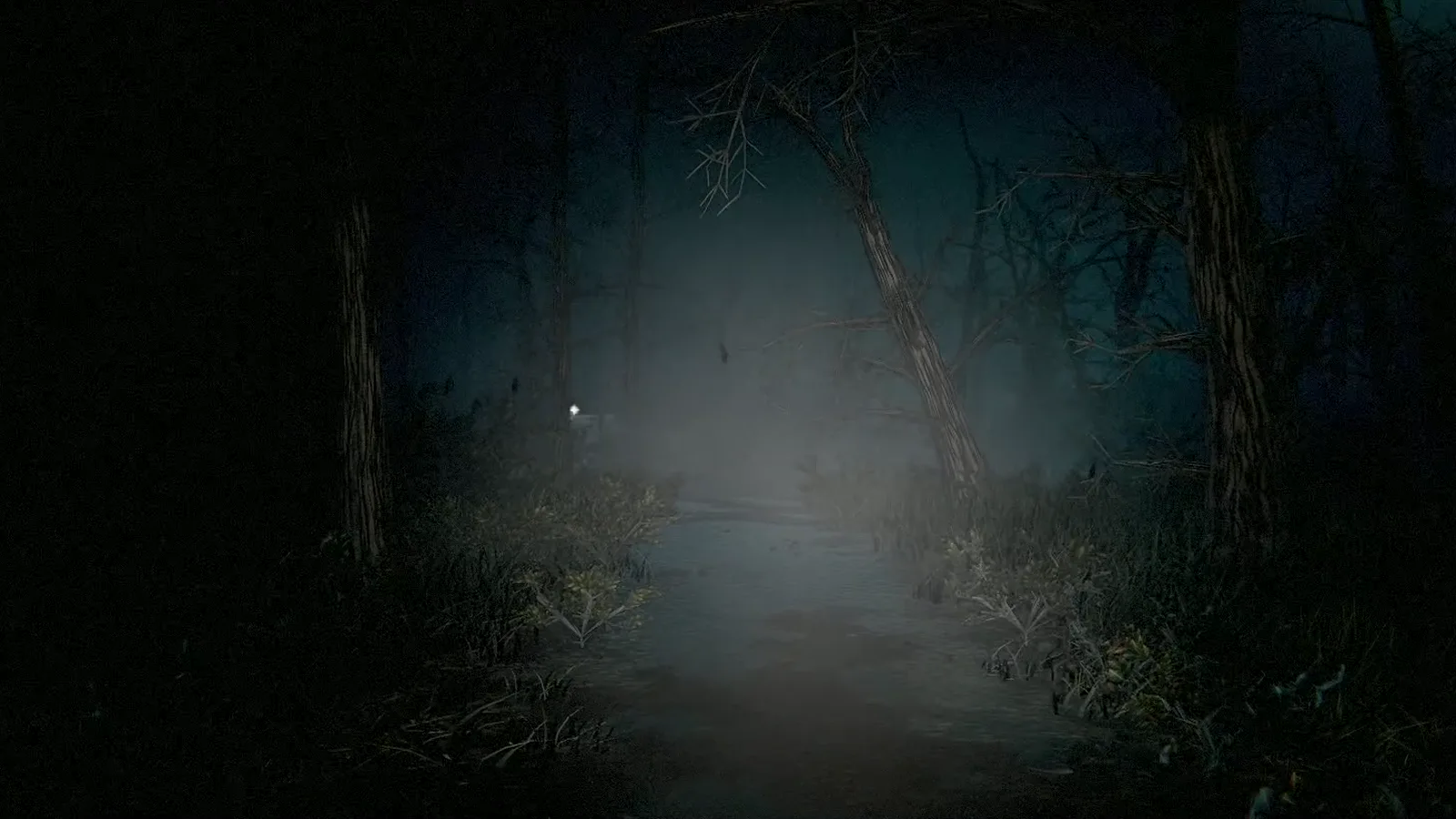
A road with no arrow #
Part One is a road of about 900 m, measured at 895 m, from the start in the south to a gate in the north. It has three forks. At every fork one way is true and the other is a decoy that ends in a dead end: a cabin, a shack by the water, a field of scarecrows.
The game does not tell you which is which. It gives you a language of signs: claw marks that lean toward the way, red rags tied on trunks, a raven carved in the bark, sticks laid as an arrow, a candle stub, boot prints in the mud. Crossed sticks and charms hung on a string are warnings. You also find eight notes that teach the signs, and four fragments of a torn map that you complete piece by piece. The map is a sheet of paper held in your hand, and you can walk with it up.
The north is a pale light in the haze, and a bell far off in the village tolls from that direction. If you are lost for long enough, measured in metres walked and never in seconds, the help rises: the bell is louder, the light swells and ravens settle in the trees along the true road.
How the signs are placed, and how I know a fork is fair, is its own post.
Fear is the only thing that hurts #
There is a thin bar of nerve at the top left and three small ravens. Fear wears the bar down, running wears it down a little, and it mends when you are left alone. At zero you faint and lose a raven.
Now and then something starts to follow you. First the crows go quiet and the wind drops. Then the torch sputters, whispers come from one side and the lens warps. At its worst there is a whine in your ears, and even the pale light in the north lies to you. It cannot be fought. The game asks for two things in the middle of the screen: get down, light off, and then don't move.
The flashlight is the part that I changed my mind about. The post on the presence says how.
Past the gate #
At the end of Part One the road goes down to a village and up a hill to a manor. The manor is twelve rooms on four levels and a chain of locks: a key, a riddle in the library, a piano, valves in the cellar, five busts turned to the road and a telescope. Nearby are an old salt mine, five more houses you can enter from the village square, and a black lake with a rowboat at the end of a dock.
There is also a mode called The Long Night. It plays the road of Part One again in a different forest, from the start to the gate, and scores how steady you kept your nerve. It never touches your saved game.
How it looks #
The look has a short list of rules. It is cold, wet and dim, in desaturated teal and grey. Fog does the depth work, with layers of dead trunks fading into a haze. The flashlight, in a warm white, and a ritual red are the only warm colors in the whole game. And it should feel like cinema, not like a game interface: shallow depth of field, lens distortion at the edges, grain and bloom.
The one real light you carry is a photometric flashlight, which is the subject of another post.
On a phone #
Touch controls appear by themselves on a touch screen: a floating joystick under the left thumb, a drag on the right to look, and buttons for use, light, run, crouch, map and notes. WebGPU needs a secure address, and an iPhone or iPad needs iOS or iPadOS 26 or later. If the game cannot start, it writes the facts on the page (the address, whether it is secure, navigator.gpu, the adapter's limits, the first errors) with a button to copy them, so a screenshot is a good bug report. A phone starts on the medium quality profile.
Credits #
The forest, its trees, plants and ground are generated in code from a seed. Not everything is: some models are CC BY or CC BY-SA work by other artists (the cemetery pack, the gate, the crow, the Grey, the paper of the map, a hand holding a phone), the manor's furniture and surfaces are CC0 from Poly Haven, and many sounds are recordings or were made with a sound-effects model. The Credits page in the game lists every one of them with its author and license.
Play it #
Ravenhush is free at ravenhush.vercel.app, and the project page here has the video: Ravenhush.
Related projects
- Ravenhush — Free sci-fi horror game for the browser